
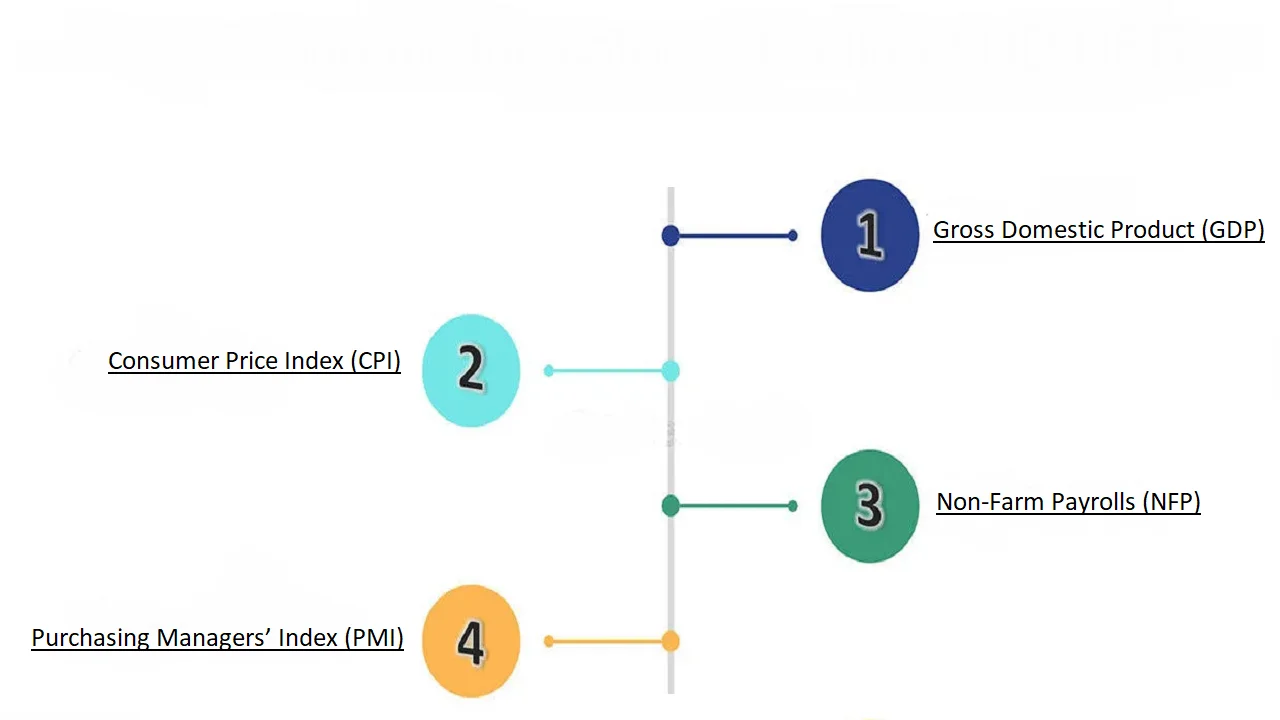
Economic indicators are official reports and statistics released by governments or financial institutions that reflect a country’s economic performance. They help traders understand:
- Whether an economy is growing or slowing
- How businesses and consumers are behaving
- What central banks might do next
- The overall strength or weakness of a currency
These reports are released on a regular schedule—daily, weekly, monthly, or quarterly—and instantly impact the forex market.
Why Economic Indicators Matter in Forex Trading
Currency values are directly tied to a country’s economic health. Strong economic data makes a currency more attractive, while weak data often causes it to fall.
Here’s why economic indicators influence the forex market:
1. Predicting Central Bank Decisions
Central banks rely on economic data to set interest rates.
For example:
- High inflation may lead to rate hikes.
- Weak employment data may result in rate cuts.
Forex traders monitor indicators to anticipate these moves.
2. Measuring Economic Strength
Positive data builds confidence in a currency; negative data reduces investor interest.
These shifts in sentiment create market trends.
3. Triggering Volatility
Major indicators can cause the market to move rapidly within seconds of release.
Traders must be prepared for sudden spikes or reversals.
Key Economic Indicators Forex Traders Should Watch
Here are the most important indicators that move the forex market:
1. Gross Domestic Product (GDP)
Gross Domestic Product (GDP) is the total monetary value of all finished goods and services produced within a country’s borders over a specific period, typically a year.
- High GDP growth → Stronger currency
- Low or negative GDP → Weaker currency
It provides a broad overview of economic performance.
2. Consumer Price Index (CPI)
The Consumer Price Index (CPI) in the forex market is a key inflation indicator that impacts currency values by influencing central bank monetary policy, such as interest rate adjustments. A higher-than-expected CPI signals inflation, potentially leading a central bank to raise interest rates, which typically strengthens the country’s currency by attracting foreign investment seeking higher returns.
- Consumer Price Index (CPI) measures price changes for consumer goods.
- Producer Price Index (PPI) measures price changes for producers.
Inflation affects interest rates, making CPI and PPI crucial for traders.
3. Non-Farm Payrolls (NFP)
Non-Farm Payrolls (NFP) is a key monthly U.S. economic report that significantly impacts the forex market by affecting the U.S. dollar and creating trading opportunities. The report tracks the number of jobs added or lost, along with other data like the unemployment rate and average hourly earnings, providing insights into the health of the U.S. economy and influencing Federal Reserve interest rate decisions
- Non-Farm Payrolls (NFP) – one of the most market-moving reports
- Unemployment Rate – percentage of jobless workers
Strong employment numbers usually boost the currency.
4. Purchasing Managers’ Index (PMI)
In the forex market, the Purchasing Managers’ Index (PMI) is a key economic indicator based on surveys of purchasing managers that provides insight into economic health and future trends.
PMI measures business activity in manufacturing and services.
A reading above 50 signals expansion, while below 50 indicates contraction.
PMI influences market sentiment and future policy expectations.